Showing posts with label Dungeness. Show all posts

Monday, 17 March 2025

Caspian Gull

In the past, I have overlooked or taken for granted migrating gulls offshore as there is usually something else going on but these days with bird numbers having declined so much I now notice movements of gulls with a little more interest. The other day a couple of flocks of migrating Black-headed Gulls brightened what was otherwise a dull 90 minute sea watch at the Point.

Migrating Black-headed Gulls

A few Caspian Gulls have been occurring on the RSPB Reserve and today I picked up what I thought was a Caspian Gull on the ARC pit but on review of photos is quite clearly not one and then on Burrowes I found a brute of a Caspian that I think is in its 2nd or 3rd Calendar Year.


Caspian Gull


Caspian Gull

Friday, 7 March 2025

The Dungeness Kent and Sussex Pintail Records

On Friday 21st February 2025 a total of  994 Pintail passing east, a record count for the site, were recorded from within the sea watching hide at Dungeness Point.

However, this was soon to be eclipsed by events that unfolded today. There was an incredible movement of Pintail observed from the Point throughout the day, at times comprising flocks of up to 300 birds and concurrent flocks passing at different heights. Some of the flocks were stratospheric and would easily have been missed if the team of Martin C, Jacob S, David W, Richard W, Owen L, Colin T and myself were not outside of the sea watch hide. Early morning, all bar Jacob who was outside, started the watch from inside the sea watch hide having recorded a few small flocks of dabbling ducks going east. Things didn't really start until Jacob who had decided to check the Trapping Area noticed flocks of duck going high east over the power station and the desert which we could not see from the hide. By 11:00 we thought that the passage had started to reduce and all apart from Jacob left for breakfast however, if anything the passage picked up and by 13:00 Jacob had recorded 1,900 Pintail east. By 13:30 the team were back in situ outside of the hide and watched hundreds of additional Pintail passing east. 

Quite a few of the flocks we picked up off and over the Sussex coastline and therefore today is a day of two records for Dungeness. One is the Kent record for Pintail in which we recorded a total of 3,705 east in 11 hours and the other is undoubtably the Pintail record for Sussex given the number of flocks we picked up off and over the Sussex coastline, this will remain a slightly smaller but unknown total! 

It makes you wonder how many Pintail we missed on the 21st February?


Mixed flock of Pintail and Shoveler


Pintail just coming out of the glare


An incredible sight of a high flock of 120 migrating Pintail 


Pintail


Pintail beyond the range boat

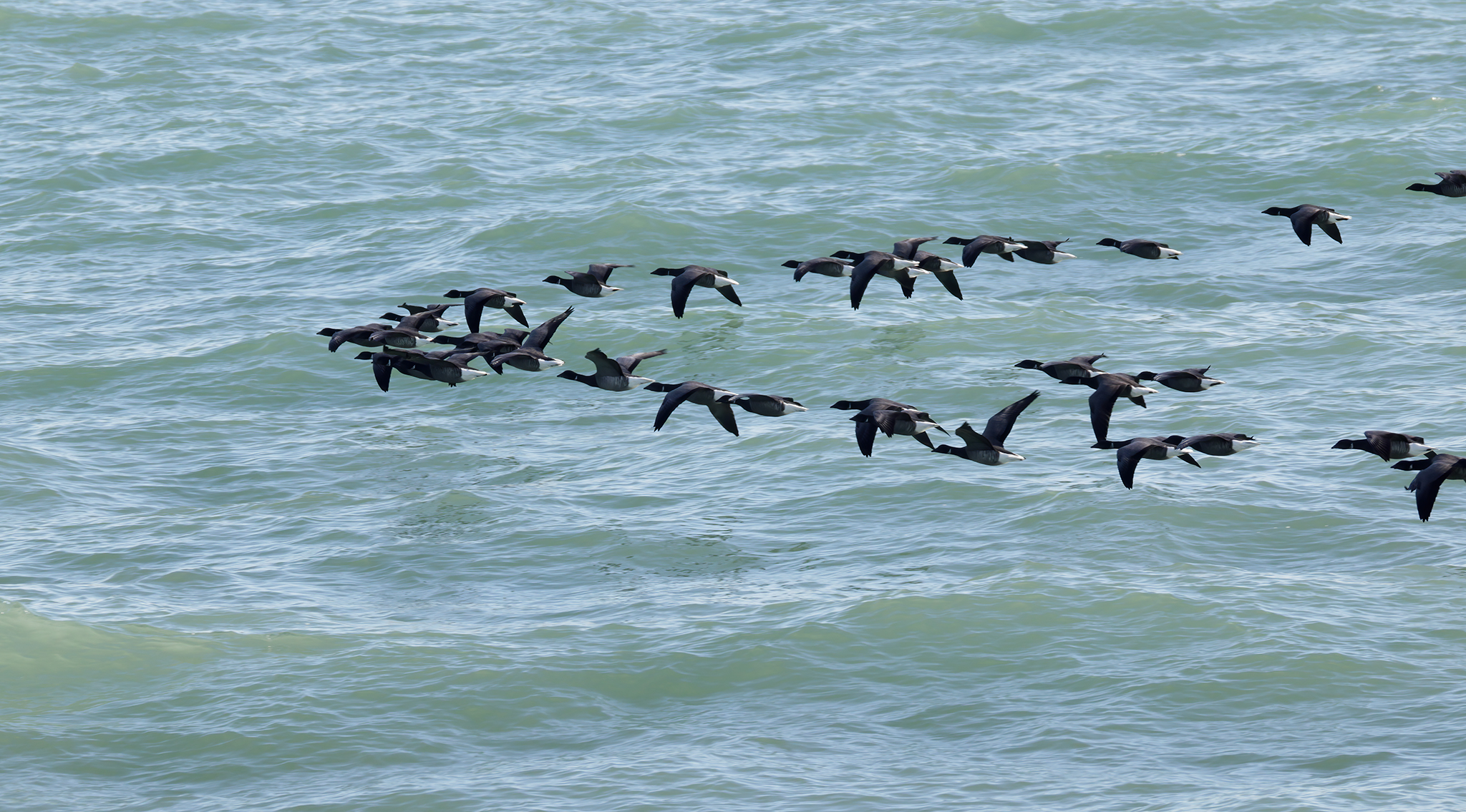
Counting close flocks of migrating Gannets and even closer flocks of migrating Brent Goose also kept us busy. 


Gannet


Dark-bellied Brent Goose


Dark-bellied Brent Goose

Friday, 21 February 2025

Pintail Record

A brilliant February sea watch today with a packed hide early morning in anticipation of something happening on the strong south/south east wind. A total of 7:45 hours of watching was completed with the highlight of the day being a movement of Pintail with 994E and breaking the previous Dungeness day record of 860. The supporting cast of birds included some oddities including a flock of 28E Greylag goose and 13W Stock Doves both groups originally coming in from the south east. 


Pintail


Pintail


Pintail


Pintail


There was also a reasonable movement of Dark-bellied Brent Goose with 2,283E being recorded.

Dark-bellied Brent Goose

Dark-bellied Brent Goose in the glare

Adult Mediterranean Gulls starting to moult in to summer plumage were also going past, with 60 recorded.


Five Mediterranean Gulls, part of a passing flock of nine.

Friday, 27 December 2024

Gulls in the fog

The RSPB visitor centre is closed over the Christmas week so volunteers are opening and closing the main entrance gate. This morning was my turn but on arriving the main gate was already open, presumably by the shepherd so I was in the main car park by 8:35. Initially the fog bank was still east of Burrowes Pit but gradually it came further west and soon made viewing conditions tricky.

Burrowes Pit

Burrowes Pit

Incredibly there were no Cormorants on any of the islands that are still visible and this meant a few more bathing and roosting gulls were in evidence including at least three Caspian Gulls of various ages and two Yellow-legged Gulls.

The Great Northern Diver had moved from New Diggings on to Burrowes but was feeding along the far edge and not at all close. The Long-tailed Duck remains on New Diggings.

Caspian Gulls (centre) 1st winter and 4th CY

Caspian Gull 1st winter

Yellow-legged Gull adult behind an adult Herring Gull

I hadn't seen the above Yellow-legged Gull and only noticed it when checking my photos of the Yellow-legged Gull below.

Yellow-legged Gull 3rd/4th CY

Thanks to MC aka Ploddingbirder for pointing out a first winter Caspian Gull at the left of the above photo.


Sunday, 22 September 2024

 Weather

Overcast with occasional showers heavier in the late afternoon and evening. SE to ESE wind generally light 10 to 15kmph gusting to 27kmph.

I started the day by checking the top of the Long Pits and had 36 Chiffchaffs and six Blackcaps in a small area of willows just by the Power Station turn off with a foraging flock of Long-tailed Tits. Flocks of Swallows and Meadow Pipits were noticeable moving east and I had two calling Tree Pipits whilst walking down the north east side of the Pits. Martin posted that a huge hirundine movement was underway from the Fishing Boats so I decided to head in that direction, leaving my car at the top of the Long Pits. On the way down I recorded 257 Swallows and 82 Meadow Pipits plus 193 House Martins heading east bit this was peanuts compared to what was actually happening across the peninsula. When I arrived at the Fishing Boats Steve Gale and Martin had been counting since early morning and had already racked up over 100,000 birds heading east out to sea. I started to help with the count and it was totally incredible. There was a huge flock of hirundines over the Power Station, something like 3,000 to 4,000 birds and large flocks of mainly House Martins were crossing the Desert and heading out to sea forming a carpet of birds flying low across the water. Between 9:45 and 10:15 I recorded c.4,100 hirundines mostly House Martins with minute counts of 200-300 birds. Earlier that morning minute counts had been between 2,000-3,000 birds so the movement was slowing down. We stopped counting at 10:15 as Martin received a txt message from Dave Bunney something like 'URGENT, possible Bonelli's Warbler'. We packed up quickly with birds still moving but longer gaps in-between the flocks. 

Standing outside Dave Bunney's garden the Western Bonelli's Warbler showed well sometimes calling and favouring the Scots Pine, Cyprus and Strawberry trees. It remained there for the rest of the day.

The RSPB Reserve was closed today due to staff shortages so later in the day, I used my bike and checked out Burrowes and ARC. On Burrowes I had 490 Lapwing, 1 first winter Caspian Gull, 191 Great Black-backed Gulls, 48 Lesser Black-bakced Gulls, 35 Wigeon, 500 Sand Martins and a single Pintail. On ARC, 42 Lapwing, 18 Redshank, a single Golden Plover, 13 Wigeon, five Pintail, two Snipe, a single Garganey and the Glossy Ibis.

Water levels gradually rising on ARC due to all the recent rainfall.

Creation of new island at Dengemarsh.


The material being raised is heavy clay but the Gulls like it.

Adult female Wheatear by the Power Station road.

The cloud of mostly House Martins at the Power Station.


Western Bonelli's Warbler


1st Winter Caspian Gull


Pintail


Redshank


Thursday, 12 September 2024

Weather

Cold early morning, 15°C daytime high. Dry for most of the day with showers, some heavy in the afternoon. NW 14-16mph.

View looking at the south east side of the Trapping Area.

The Desert east of the Trapping Area.

I started the day in the Desert at the Point, taking a wide route near to the railway station and then on to the Sanctuary. Three Red Foxes were evident warming up in the morning sunshine. 


Two flocks of 11 and six Stonechats were foraging amongst the gorse along with a two Whinchats and a Redstart. Occasionally Meadow Pipits would fly over heading west indicating that a movement albeit in low numbers was happening. I recorded 17w.


Meadow Pipit


Whinchat

Whilst at the northern end of the Desert I was fortunate to be in the right place to pick up a juvenile Honey Buzzard which ended up circling over the Point and Long Pits before heading off north-west over ARC and Lade. It or another was later seen perched in willow from the Polish War Memorial. Kestrels are not keen on the intrusion in to their air space and monitored the movements of the Honey Buzzard. At least 19 Kestrels were recorded in the Desert area.


Honey Buzzard juvenile being mobbed by a Kestrel.

I then visited the RSPB Reserve and checked out Burrowes Pit. The White-winged Black Tern and at least 11 Black Terns were still present. An unexpected heavy rain shower caused the White-winged Black Tern to make a most bizarre head movement. After the rain shower, a couple of Black Terns decided it was time for a wash.

White-winged Black Tern (right) and Black Tern (left) 


Washing Black Terns


Bizarre head movement by the White-winged Black Tern


White-winged Black Tern

Butterflies were noticeable in the Desert with Small Copper, Small Heath, Red Admiral and a couple of Peacocks.

Peacock Butterfly

Whilst watching the terns feeding, a begging juvenile Goldfinch with an adult appeared on the Teasels in front of Dennis's Hide.