Showing posts with label Pintail. Show all posts

Thursday, 29 January 2026

Dungeness RSPB Reserve Catchup

 On 2nd January the Great Northern Diver has a good right eye.


On 16th January, the diver looks like it has lost its right eye, although it could just be asleep? Seems to have moved on now, last seen on the reserve on Thursday 22nd January.

In the willows near the Pines, a couple of Firecrests were in the company of several Goldcrests and a couple of Chiffchaffs within a roving Tit flock.


The flock of Bewick's Swans remain on Walland Marsh with Nadine the neck-tagged female from north-east Europe.


A large flock of c.1,300 Fieldfare at Hawthorn Corner on Walland Marsh was an impressive recent surprise. Where did they come from? Another 200 flew up from around Coldharbour Farm.

Compared to the winter of 2024/2025 the number of Goldeneye on the reserve is far fewer this winter. The maximum I have seen is six.

Greater White-fronted Geese flying around Dengemarsh. After a gap of a couple of weeks, a flock appeared at Beaconsfield on Walland. 

Always a treat to see, numbers of Jack Snipe being found on the reserve is less than last winter. Without thermal cameras it is likely that we wouldn't be finding them at all. The great aspect of looking for them with thermal cameras is that we don't flush them.

During the strong winds earlier in the month several hundred Lapwings attempted to roost on the islands at Burrowes Pit. 

Never a common bird on the reserve, but recently there have been upto four Pintail making use of ARC and Burrowes Pits.

It can be difficult to record Snipe on the reserve but the islands at New Excavations have become a good place to see them. There are nine in this photo.

Snipe

On ARC, the anti-mammal fencing is used by resting duck as an anchor. Previously I have seen Wigeon making use of it and this time mostly Teal.

Tuesday, 29 July 2025

Duck Counting and a Good Wader

I decided to count ducks and coot on the RSPB reserve today as I was interested to know if the numbers of moulting duck had changed significantly from earlier in the month. I counted the main pits on the reserve ARC, New Diggings, Burrowes, Dengemarsh and New Excavations, I didn't get to Kerton or Lade.

The numbers at the end of the day were:
Pochard 798
Gadwall 769
Tufted Duck 361
Mallard 111
Shoveler 75
Pintail 2
Teal 42
Red-crested Pochard 1
Garganey 2
Coot 833

Pochard numbers are down from the mid month count but Tufted and Shoveler are up and Gadwall is about the same.

On approaching the far end of ARC, I managed to flush all the duck and Lapwing roosting in the vegetation at the muddy patch there but that did make the duck easier to count as they swam further out in to more open water. As the Dungeness road can be quite dangerous to walk along, I decided to count New Diggings from inside the fence on the ARC side but then considered counting from the eastern end of ARC. As I wandered back to my car I glanced at the muddy patch and noticed a couple of waders at the waters edge which I hadn't noticed previously. On looking through my scope I was surprised to see an adult Pectoral Sandpiper and less surprised to see a Common Sandpiper.

Adult Pectoral Sandpiper with Common Sandpiper

Adult Pectoral Sandpiper


Adult Pectoral Sandpiper

The Common Tern colonies on Burrowes and Dengemarsh still have growing chicks, with 4 visible at Dengemarsh and 5 at Burrowes. There is a significant age difference between the visible chicks at Dengemarsh with one chick not far from fledging whilst others look to be less than a week old and adults seem to still be displaying. 

Common Tern chick maybe less than a week old

Common Tern chick getting close to fledging

One of the 2 Pintail on the Reserve today an odd July record

Friday, 7 March 2025

The Dungeness Kent and Sussex Pintail Records

On Friday 21st February 2025 a total of  994 Pintail passing east, a record count for the site, were recorded from within the sea watching hide at Dungeness Point.

However, this was soon to be eclipsed by events that unfolded today. There was an incredible movement of Pintail observed from the Point throughout the day, at times comprising flocks of up to 300 birds and concurrent flocks passing at different heights. Some of the flocks were stratospheric and would easily have been missed if the team of Martin C, Jacob S, David W, Richard W, Owen L, Colin T and myself were not outside of the sea watch hide. Early morning, all bar Jacob who was outside, started the watch from inside the sea watch hide having recorded a few small flocks of dabbling ducks going east. Things didn't really start until Jacob who had decided to check the Trapping Area noticed flocks of duck going high east over the power station and the desert which we could not see from the hide. By 11:00 we thought that the passage had started to reduce and all apart from Jacob left for breakfast however, if anything the passage picked up and by 13:00 Jacob had recorded 1,900 Pintail east. By 13:30 the team were back in situ outside of the hide and watched hundreds of additional Pintail passing east. 

Quite a few of the flocks we picked up off and over the Sussex coastline and therefore today is a day of two records for Dungeness. One is the Kent record for Pintail in which we recorded a total of 3,705 east in 11 hours and the other is undoubtably the Pintail record for Sussex given the number of flocks we picked up off and over the Sussex coastline, this will remain a slightly smaller but unknown total! 

It makes you wonder how many Pintail we missed on the 21st February?


Mixed flock of Pintail and Shoveler


Pintail just coming out of the glare


An incredible sight of a high flock of 120 migrating Pintail 


Pintail


Pintail beyond the range boat

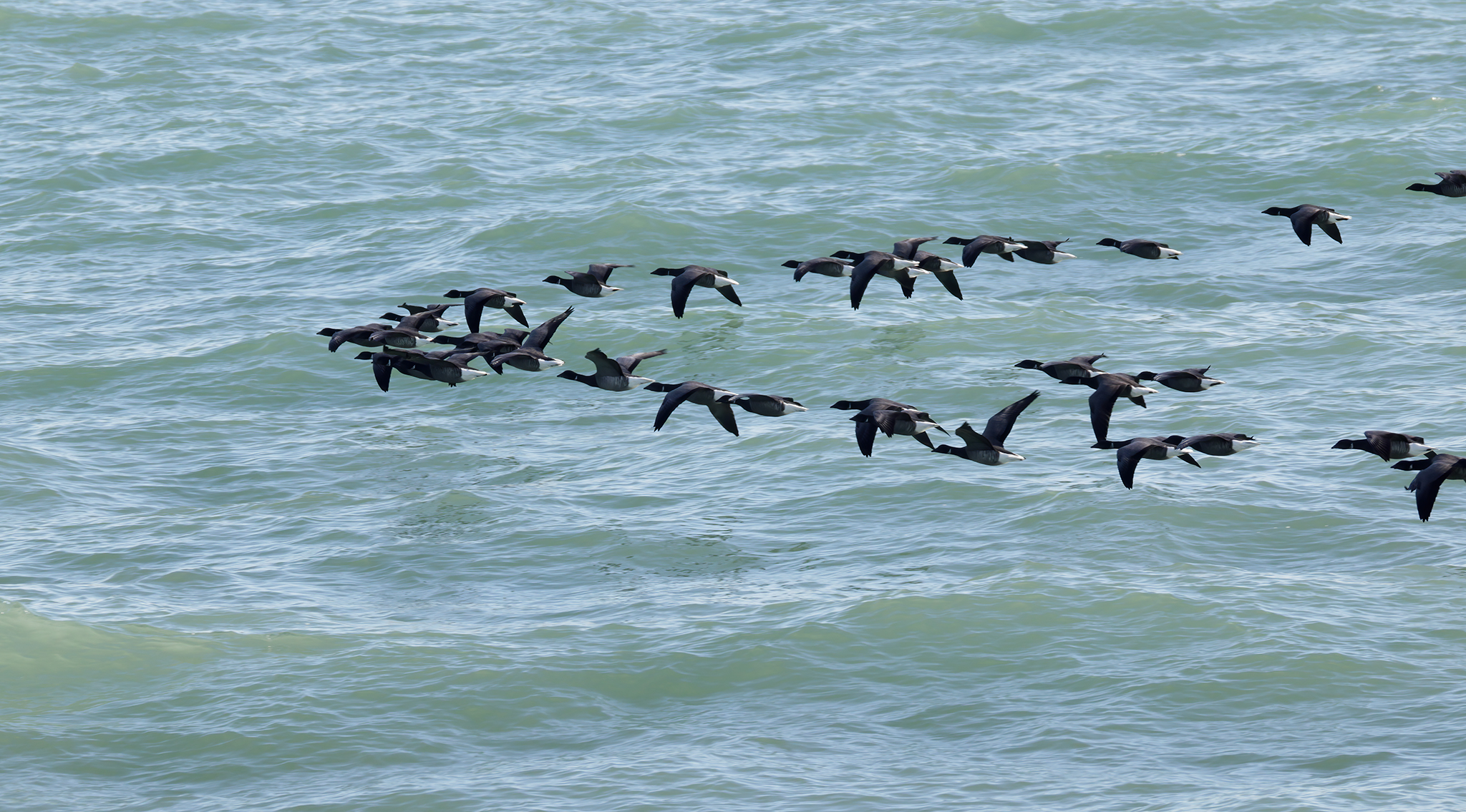
Counting close flocks of migrating Gannets and even closer flocks of migrating Brent Goose also kept us busy. 


Gannet


Dark-bellied Brent Goose


Dark-bellied Brent Goose

Friday, 21 February 2025

Pintail Record

A brilliant February sea watch today with a packed hide early morning in anticipation of something happening on the strong south/south east wind. A total of 7:45 hours of watching was completed with the highlight of the day being a movement of Pintail with 994E and breaking the previous Dungeness day record of 860. The supporting cast of birds included some oddities including a flock of 28E Greylag goose and 13W Stock Doves both groups originally coming in from the south east. 


Pintail


Pintail


Pintail


Pintail


There was also a reasonable movement of Dark-bellied Brent Goose with 2,283E being recorded.

Dark-bellied Brent Goose

Dark-bellied Brent Goose in the glare

Adult Mediterranean Gulls starting to moult in to summer plumage were also going past, with 60 recorded.


Five Mediterranean Gulls, part of a passing flock of nine.

Thursday, 30 January 2025

Black-necked Grebe

The six Pink-footed Goose were back on Boulderwall Fields this morning and later re-located with a Greylag flock to Lydd Fields viewable from Dengemarsh Road. A glorious blue sky day with a light northerly breeze made photography tricky. Still plenty of displaying Goldeneye on Burrowes and New Diggings and the long staying Long-tailed Duck still on New Diggings. A single Water Pipit was feeding on Hayfield 2 and Richard found a Black-necked Grebe on Dengemarsh where a female Pintail was also present. Lapwing numbers appear to be building with a count of 1,114 across the reserve today.

Water Pipit

Water Pipit

Pintail (female)
Pintail is an annual visitor to the reserve but usually in low numbers.

Black-necked Grebe

Bleck-necked Grebe

Sunday, 22 September 2024

 Weather

Overcast with occasional showers heavier in the late afternoon and evening. SE to ESE wind generally light 10 to 15kmph gusting to 27kmph.

I started the day by checking the top of the Long Pits and had 36 Chiffchaffs and six Blackcaps in a small area of willows just by the Power Station turn off with a foraging flock of Long-tailed Tits. Flocks of Swallows and Meadow Pipits were noticeable moving east and I had two calling Tree Pipits whilst walking down the north east side of the Pits. Martin posted that a huge hirundine movement was underway from the Fishing Boats so I decided to head in that direction, leaving my car at the top of the Long Pits. On the way down I recorded 257 Swallows and 82 Meadow Pipits plus 193 House Martins heading east bit this was peanuts compared to what was actually happening across the peninsula. When I arrived at the Fishing Boats Steve Gale and Martin had been counting since early morning and had already racked up over 100,000 birds heading east out to sea. I started to help with the count and it was totally incredible. There was a huge flock of hirundines over the Power Station, something like 3,000 to 4,000 birds and large flocks of mainly House Martins were crossing the Desert and heading out to sea forming a carpet of birds flying low across the water. Between 9:45 and 10:15 I recorded c.4,100 hirundines mostly House Martins with minute counts of 200-300 birds. Earlier that morning minute counts had been between 2,000-3,000 birds so the movement was slowing down. We stopped counting at 10:15 as Martin received a txt message from Dave Bunney something like 'URGENT, possible Bonelli's Warbler'. We packed up quickly with birds still moving but longer gaps in-between the flocks. 

Standing outside Dave Bunney's garden the Western Bonelli's Warbler showed well sometimes calling and favouring the Scots Pine, Cyprus and Strawberry trees. It remained there for the rest of the day.

The RSPB Reserve was closed today due to staff shortages so later in the day, I used my bike and checked out Burrowes and ARC. On Burrowes I had 490 Lapwing, 1 first winter Caspian Gull, 191 Great Black-backed Gulls, 48 Lesser Black-bakced Gulls, 35 Wigeon, 500 Sand Martins and a single Pintail. On ARC, 42 Lapwing, 18 Redshank, a single Golden Plover, 13 Wigeon, five Pintail, two Snipe, a single Garganey and the Glossy Ibis.

Water levels gradually rising on ARC due to all the recent rainfall.

Creation of new island at Dengemarsh.


The material being raised is heavy clay but the Gulls like it.

Adult female Wheatear by the Power Station road.

The cloud of mostly House Martins at the Power Station.


Western Bonelli's Warbler


1st Winter Caspian Gull


Pintail


Redshank