Monday, 21 July 2025

A Lesson in Identifying a Little Stint

I was checking the various islands that have appeared on Burrowes Pit near Dennis's Hide at RSPB Dungeness for any interesting waders and counting the distant Ringed and Little Ringed Plovers and Common Sandpipers when I came across a small wader that looked odd. It was smaller than the nearby Little Ringed Plovers and I couldn't identify it, bugger! I thought it looked like a small sandpiper and just as I was grabbing my camera it flew. Luckily it landed on a group of closer islands and I took a load of poor photos. I thought it might be a Baird's Sandpiper but it wasn't quite right and I still couldn't make an identification. There was no one else around and I was panicking, I tentatively put out a message on the Locals group. Shortly afterwards locals arrived and opinion on the identification was still unsure, made even trickier as the bird had disappeared. 

After a short while, I picked up a small wader distantly on islands out from Dennis's Hide and we started to check out what features we could see but still nothing seemed to make sense to clinch an id. The features that were confusing were the rufous tones to the scapulars and the dull brown/grey breast band. There was plenty of discussion and features mentioned such as mantle tramlines and a split supercilium  should have drawn us to a positive identification but I think it is fair to say that the colour and appearance of the breast band drew us away from the fact that it is a moulting adult Little Stint, likely the first returning adult of the autumn.

To be honest, I was expecting to see more reddish tones around the head and breast not the dull looking brownish/grey (or at least that's what the colours look like to me) and that one expectation blocked out the fact that it was a Little Stint, until after going around and around with other possible id's, that's all it could be.

Looking at the photos now, it is so much more obviously a Little Stint but even checking photos at the time when the bird was in view it just wasn't obvious. 

It had been one of those occasions when I had to make a decision on whether to take time trying to identify the bird before informing others and risk losing it or having a quick go at identification and then making a call.  

The photos below of the moulting adult Little Stint are cropped images taken from outside Dennis's Hide shortly after I first found the bird.   


Later in the afternoon, I was standing at the Firth Lookout when the same adult Little Stint suddenly appeared and this time much closer.


However, 682 miles to the north a moulting adult Baird's Sandpiper turned up at Houb, Baltasound on Shetland, oh well!


Common Sandpipers continue to increase with 12 at ARC and at least 3 on Burrowes. MC and RW had 4 Green Sands at ARC whilst I could only locate 1. Whilst standing at Firth Viewpoint a flock of 6 LRP's (2 adults and 4 juveniles) appeared and after a few minutes moved on to be replaced by 3 Ringed Plovers. Also from Firth Viewpoint were 3 Greenshanks, a 2CY Little Gull and a Wood Sandpiper.

Adult Greenshank

Adult Greenshank

Juvenile and adult, 2 of the 3 Greenshanks from Firth Viewpoint

2CY Little Gull

Wood Sandpiper

Wood Sandpiper

Thursday, 17 July 2025

Moulting Ducks and Returning Waders

In July and August duck numbers on the RSPB Reserve increase, especially Pochard and Gadwall as males visit the pits on the reserve to moult and obtain their eclipse plumage. I've been making counts on behalf of the RSPB for a few years now and this year noticed the numbers of males arriving at the reserve start to significantly increase from about mid-June. 

So it was a busy day today as I tried to do a duck count across the reserve and managed to reach a total of 1,006 Pochard and 636 Gadwall. An additional 180 Pochard were counted on Lade Pits which is also part of the RSPB Reserve. I think that makes the second highest count (1,186) of Pochard on the reserve since I moved to the area back in 2019.

3 Garganey are now in residence with two preferring ARC and the third on Burrowes. The female Red-crested Pochard and duckling remain on ARC with an eclipse male Red-crested Pochard on Dengemarsh.

The remaining Common Tern colonies on Dengemarsh and Burrowes are still producing chicks with 8 on a very noisy colony from Dengemarsh Hide today and hopefully more than the one I saw back on the 12th July at Burrowes.

Returning wader numbers are gradually increasing with 4 Wood Sandpipers, 1 Greenshank, 1 Redshank, 18 Little-ringed Plovers, 2 Ringed Plovers and 10 Common Sandpipers.

Almost fledged Common Tern chicks at Dengemarsh

Plenty of squabbling when an adult makes an appearance

Common Sandpiper

Kestrel at the Hayfields

Greenshank at Firth Viewpoint

Wood Sandpiper from Hanson Hide

Whimbrel on Burrowes Pit

Garganey from Hanson Hide

Small Red-eyed Damselfly in tandem

When there were 3 Avocet Chicks back on July 8th, now sadly only 2

It is always very frustrating to come across people wandering over sections of the reserve where they are not permitted and even more so when they have a dog either on or off the lead. I don't blame this couple as the signage at ARC is (or rather was) pitiful. It is now more obvious as after encountering several dogs on sections of the reserve where they are prohibited I have put up more obvious temporary signage. No excuse now and I'll continue to be on the lookout.

The Common Tern colony on Burrowes Pit, so wonderful to have so many terns nesting compared to last year.

A trip with Martin and Richard out of the area in search of Purple Emperor butterfly ended with us not seeing that but enjoying woodland bird species that are rare or tricky to see on the peninsula.


Nuthatch, a rarity on the peninsula, this one in woodland near Hamstreet


Song Thrush, can be tricky to catch up with on the peninsula. This one giving a snail a headache using its anvil to bash the living daylights out of the snail! 

Friday, 4 July 2025

Caspian Tern

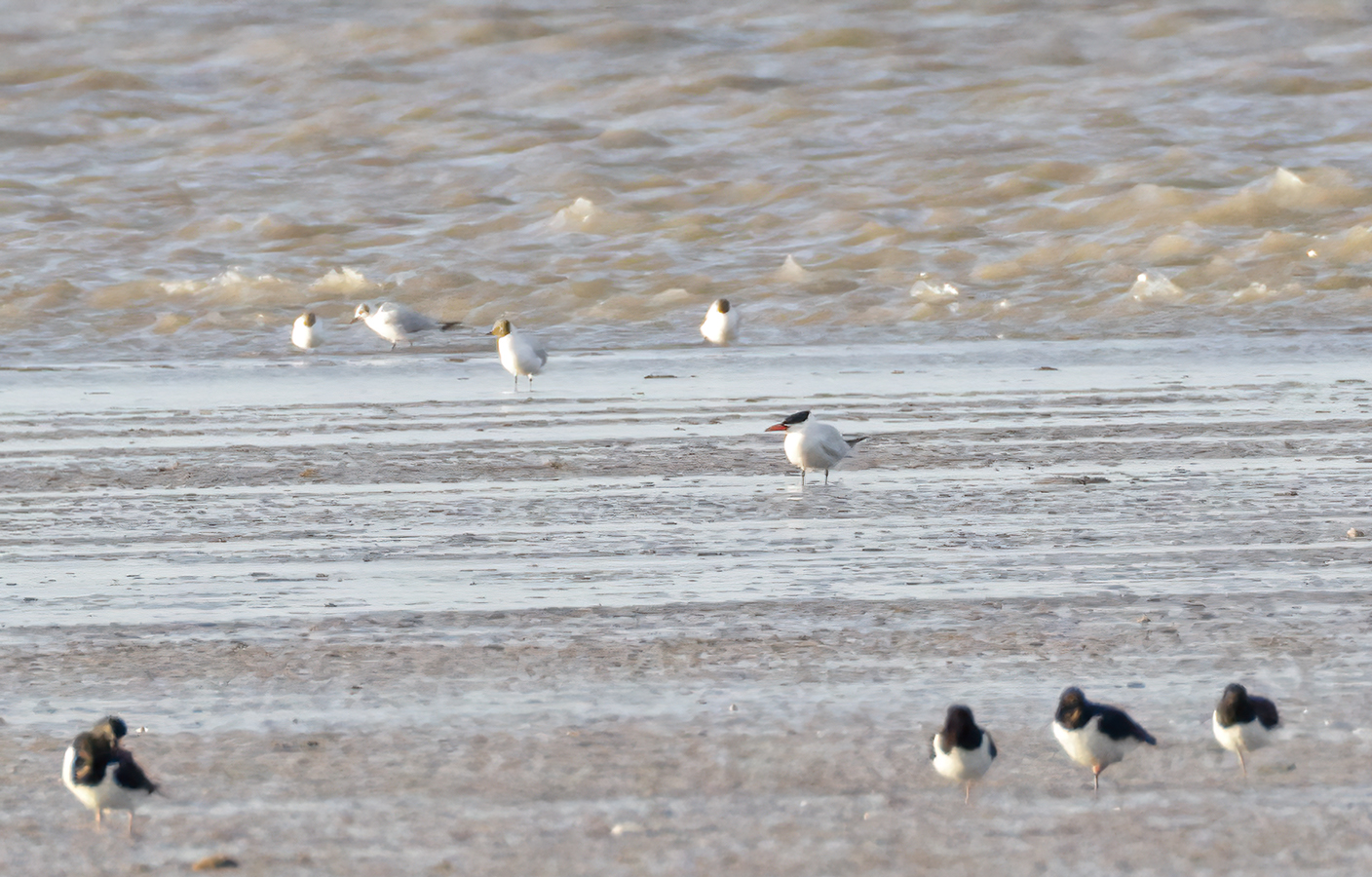
Whilst doing a late round of litter picking along the peninsular, Owen lifted his bins to find a Caspian Tern on the beach opposite the Romney Tavern! It's not often I drive at speed along the Dungeness Road but species such as this tend to have a habit of not hanging around and typically as I parked up and started to walk along the beach to join the group of locals watching the tern it flew off towards Lade car park. Luckily it returned and remained on the beach until after 21:00, presumably roosting on the exposed low-tide mud. A brilliant find by Owen.

A very happy group of locals watching the tern

Caspian Tern


Thursday, 3 July 2025

Nesting Ringed Plover Update

The nesting Ringed Plover was still sitting today, hopefully on remaining undamaged eggs.
5th July update - The Ringed Plover pair had abandoned their nesting attempt.

The four Avocet chicks are still alive and being well looked after by the adult birds.

Two chicks receiving protection from the rain

Drying off

Waders continue to visit ARC, this adult Dunlin was one of three individuals that has now increased to six.

Little Ringed Plovers have bred at ARC without us knowing. Three juveniles and one adult remain on the islands frequently getting chased by the Ringed Plovers.


The female Red-crested Pochard and remaining duckling can sometimes prove elusive to see at ARC but in the last few days have been recorded daily.

Lesser Emperor dragonflies are now also being recorded at ARC, Long Pits and at the Point.

Juvenile Bearded Tits also continue to be seen well from Hanson Hide.

Amongst the migrating waders, a moulting male Ruff


Wednesday, 2 July 2025

The Perils of Nesting Ringed Plovers

Nesting Ringed Plovers get a rough time on the peninsular. A small number of pairs still attempt to nest on the shingle at the point and in the desert areas but visitors and especially those with dogs on and off-lead cause significant levels of disturbance and can destroy nests, despite the best efforts of the estate wardens to protect the nesting birds. Foxes, badgers and the increasingly large numbers of corvids in the area also take their toll. Sometimes it is not until a second or even third nesting attempt that a small number of chicks might successfully fledge. So, it was great to be able to monitor three nesting pairs of Ringed Plovers at ARC from Hanson Hide. 

However, today a tragedy unfolded and one that was not totally unexpected.

In ten minutes she will have her nest trampled and lose an egg and chick


Sounding the alarm


Her partner arrives and the Egyptian Geese move on having narrowly missed the nest


The Egyptian Geese return not giving the Ringed Plover any peace


The adult goose narrowly misses the nest again amidst a frantic defence


The geese wander away and then return yet again, this time the Ringed Plovers don't stand a chance

The moment of destruction

Once the geese had wandered away, I watched the female return to the nest and she immediately picked up a smashed egg within which a fairly well developed chick was still attached to the egg casing. She flew off with the smashed egg and dropped it away from the nest. On returning she settled on the remaining eggs, I wonder if she will still be sitting tomorrow?