Friday, 4 July 2025

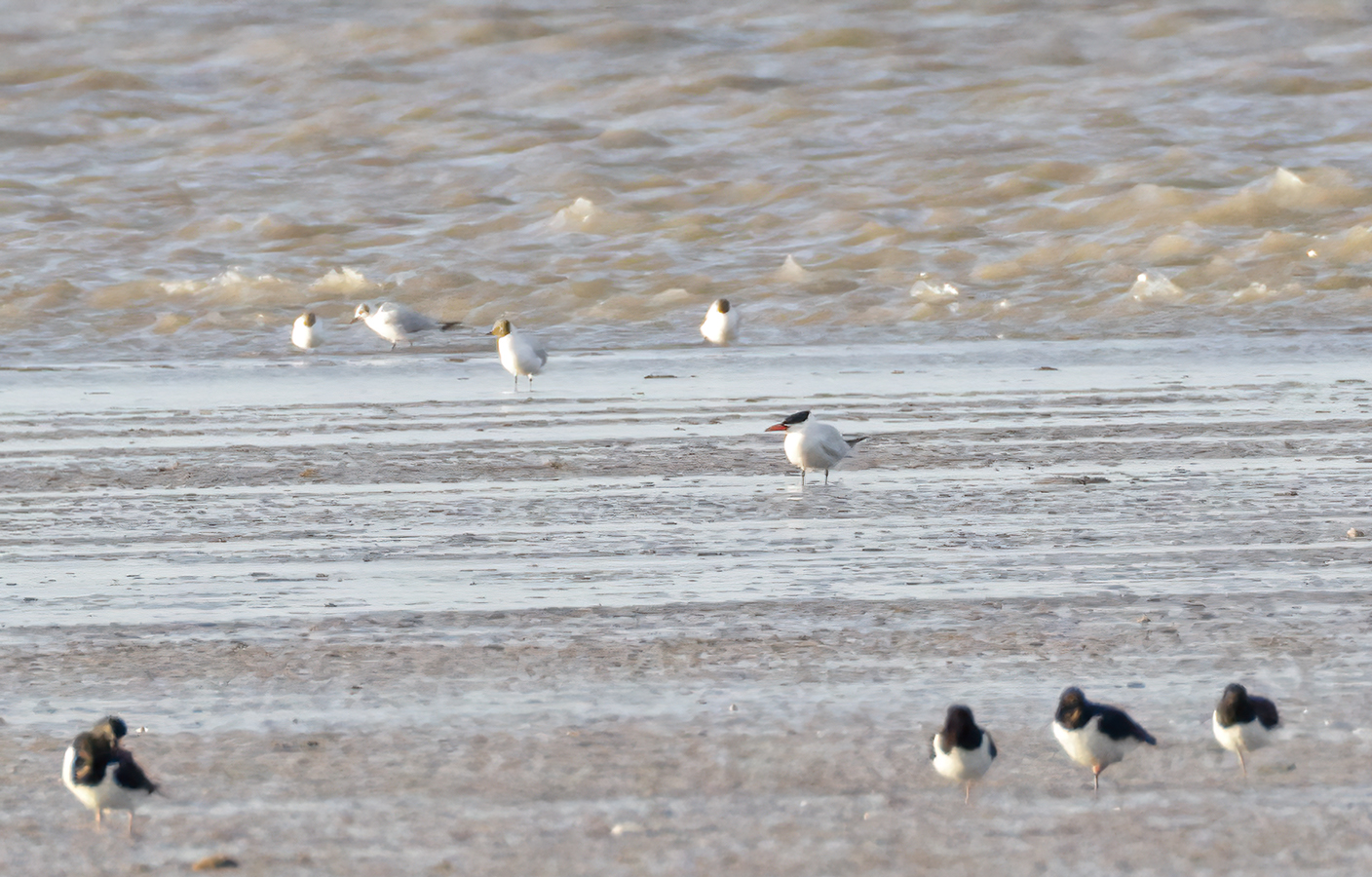
Caspian Tern

Whilst doing a late round of litter picking along the peninsular, Owen lifted his bins to find a Caspian Tern on the beach opposite the Romney Tavern! It's not often I drive at speed along the Dungeness Road but species such as this tend to have a habit of not hanging around and typically as I parked up and started to walk along the beach to join the group of locals watching the tern it flew off towards Lade car park. Luckily it returned and remained on the beach until after 21:00, presumably roosting on the exposed low-tide mud. A brilliant find by Owen.

A very happy group of locals watching the tern

Caspian Tern


Thursday, 3 July 2025

Nesting Ringed Plover Update

The nesting Ringed Plover was still sitting today, hopefully on remaining undamaged eggs.
5th July update - The Ringed Plover pair had abandoned their nesting attempt.

The four Avocet chicks are still alive and being well looked after by the adult birds.

Two chicks receiving protection from the rain

Drying off

Waders continue to visit ARC, this adult Dunlin was one of three individuals that has now increased to six.

Little Ringed Plovers have bred at ARC without us knowing. Three juveniles and one adult remain on the islands frequently getting chased by the Ringed Plovers.


The female Red-crested Pochard and remaining duckling can sometimes prove elusive to see at ARC but in the last few days have been recorded daily.

Lesser Emperor dragonflies are now also being recorded at ARC, Long Pits and at the Point.

Juvenile Bearded Tits also continue to be seen well from Hanson Hide.

Amongst the migrating waders, a moulting male Ruff


Wednesday, 2 July 2025

The Perils of Nesting Ringed Plovers

Nesting Ringed Plovers get a rough time on the peninsular. A small number of pairs still attempt to nest on the shingle at the point and in the desert areas but visitors and especially those with dogs on and off-lead cause significant levels of disturbance and can destroy nests, despite the best efforts of the estate wardens to protect the nesting birds. Foxes, badgers and the increasingly large numbers of corvids in the area also take their toll. Sometimes it is not until a second or even third nesting attempt that a small number of chicks might successfully fledge. So, it was great to be able to monitor three nesting pairs of Ringed Plovers at ARC from Hanson Hide. 

However, today a tragedy unfolded and one that was not totally unexpected.

In ten minutes she will have her nest trampled and lose an egg and chick


Sounding the alarm


Her partner arrives and the Egyptian Geese move on having narrowly missed the nest


The Egyptian Geese return not giving the Ringed Plover any peace


The adult goose narrowly misses the nest again amidst a frantic defence


The geese wander away and then return yet again, this time the Ringed Plovers don't stand a chance

The moment of destruction

Once the geese had wandered away, I watched the female return to the nest and she immediately picked up a smashed egg within which a fairly well developed chick was still attached to the egg casing. She flew off with the smashed egg and dropped it away from the nest. On returning she settled on the remaining eggs, I wonder if she will still be sitting tomorrow?

Thursday, 26 June 2025

Avocet chicks at last

At ARC it has been possible to watch five pairs of nesting Avocets amongst the islands. This is a great increase from 2024 when there were 3 nesting pairs on ARC up to the 21st June when on the 22nd this went down to only one pair which successfully fledged one young on 20th August from three chicks. Today the 26th June the first three Avocet chicks have hatched to one pair and the other four pairs remain nesting all with sitting birds.

Avocet pair with three eggs

One of the three newly hatched Avocet chicks at ARC

The female Avocet was still removing egg shells from the nest location when I watched likely meaning that the chicks could only have been hours old. What a treat.

It is still proving tricky to work out what the Common Terns are up to at ARC. I think that there are still at least 15 nesting pairs in the colony but over the past few days their behaviour has been strange. At times for no apparent reason that I can understand all the terns suddenly lift into the air and fly away from the colony area only to return after a few seconds. Whether the strong winds are causing them to spook easily as I cannot see any predators overhead, I just don't know and I wonder if we will get any chicks from this colony? Still, it does allow me to count them and this morning I had 52 in the air together. Elsewhere on the reserve there are at least four sitting common terns on Burrowes and another three sitting birds at Dengemarsh with seven to eight chicks with a couple of them near to fledging.

I wondered what this Common Tern had caught and it looks like a young Pike

Common Tern chicks at Dengemarsh

Common Tern chicks at Dengemarsh

Adult waders are starting to turn up on the reserve in low numbers, with Green, Wood and Common Sandpipers, Bar and Black-tailed Godwits and Grey Plovers.

Adult Black-tailed Godwit

Common Sandpiper

Wood Sandpiper

This adult Redshank is one that has successfully fledged one chick at ARC

Juvenile Redshank

A flock of six Mediterranean Gulls dropped in to ARC on the 25th June. One of them was ringed with a Yellow Darvic ATSS, and is likely to originate from Germany. 

Mediterranean Gull ATSS giving the hard stare to a 1st Summer Little Gull at ARC

Wednesday, 18 June 2025

Little Terns

Yesterday 17th June, I was sitting in Hanson Hide at RSPB Dungeness, trying to find the nesting Avocets, Common Terns, Ringed Plovers, Oystercatchers, Black-headed Gulls and Lapwing at ARC. Amongst the cacophony of Common Tern sound I picked up the call of Little Tern and saw two that had landed on one of the islands with a covering of stones they immediately started to behave as if they were looking for a suitable nesting location and started to wander the island and on several occasions started to form a nest scrape. Even when they were chased off by a Common Tern they appeared to be reluctant to leave and returned to the island only to the be chased off by a Little Gull. This time they departed towards Burrowes Pit and it seemed didn't reappear and have not bee seen since.

Whilst a brief visit, this is the first time that attempted breeding by Little Tern has been recorded on the peninsula since 1976 when a pair were hanging on at the Point. 


A pair of Little Terns at ARC

Elsewhere on the RSPB Reserve at Dengemarsh both Oystercatcher and Common Terns have chicks.

Common Tern with three chicks

Oystercatcher and chick

Wednesday, 11 June 2025

Rose-coloured Starling

Another great find by Jacob of a male Rose-coloured Starling initially near the Moat and then moving around the adjacent area associating with a flock of adult and juvenile Starlings.


Rose-coloured Starling

There have been up to three Little Gulls moving between the various larger pits across the RSPB Dungeness reserve.


Little Gulls

A first for the area was a breeding pair of Red-crested Pochards. First picked up on Saturday 7th June with a female and four ducklings, the family is now down to three ducklings as of Wednesday 11th June.


Female Red-crested Pochard and four ducklings

At the front of Hanson Hide a flock of four noisy juvenile Bearded Tits gave fabulous views amongst the reed stems.


Juvenile Bearded Tit

A Weasel hunting along the bridleway at Hayfield 1, always ran away from me!

Weasel